
Feeding Dogs “People Food”: Healthy Choice or Bad Habit? A Trainer’s Take
Here’s a topic that reliably sparks strong opinions: should dogs eat “people food”?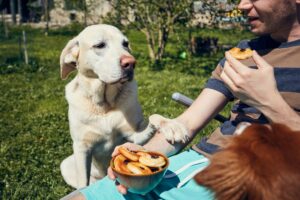
For some, it’s a hard no. For others, it’s part of everyday life. My take? It’s not nearly as black and white as people make it out to be.
Because here’s the truth: in many cases, thoughtfully chosen human food can actually be a healthier option than highly processed treats. I’m not opposed to feeding dogs human-grade food at all. What matters far more is what you feed, how much you feed, and—crucially—where and when you feed it.
And as a trainer, I’ll let you in on a little secret: a dog’s behavior will often tell me far more about what’s really going on than their human ever will.
Not All Dogs Are Motivated by Kibble
Take huskies, for example. They’re famously less food-motivated than many other breeds. That makes sense when you consider what they were bred to do.
A working sled dog can run for miles, powered as much by the joy of the work as by the occasional meal. Pulling, running, and problem-solving are inherently reinforcing—it’s their version of a runner’s high. So when we ask that same dog to “sit” for a dry biscuit, it’s often just not that compelling.
This is something I emphasize to my clients all the time:
you need to discover what your dog finds reinforcing.
Too often, people stop at copying whatever treats I happen to be using in a session. But effective training isn’t about the treat—it’s about the value to the dog. And for some dogs, that means we need to level up.
“People Food” Isn’t the Problem

Context is the problem with people food and begging
Of course, there are foods that are genuinely dangerous for dogs—chocolate, grapes, onions, and others. That part is non-negotiable.
But beyond that, it’s worth remembering: dogs evolved as opportunistic scavengers. Long before kibble existed, they thrived on leftovers from human meals. “Table scraps” were the original dog diet.
That doesn’t mean everything on our plate is appropriate. Our modern diets can be too rich, too salty, or too processed. But small amounts of fresh, simple foods—like roasted chicken, bits of lean meat, or even certain baby foods—can be excellent, high-value rewards.
In fact, for some dogs, they’re not just better—they’re necessary.
The Real Issue: Context
Here’s where things often get muddled.
Many people tell me, “I don’t feed my dog people food because I don’t want them to beg.”
Completely understandable—but slightly misguided.
Begging isn’t about what you feed. It’s about where and when the feeding happens.
If a dog is routinely given food from the table, they will learn to hang around the table. That’s just learning theory in action. You could be eating plain kibble on your plate and the dog would still stare at you if that’s where reinforcement has happened in the past.
So if you don’t want a dog hovering at your elbow during dinner, the solution isn’t necessarily to eliminate human food altogether—it’s to change the context:
- Feed your dog in their bowl
- Use human food during training sessions
- Deliver treats away from the table
Clear boundaries create clear behavior.
What Your Dog Is Telling You
I have a husky mix in Muttessori who generally couldn’t care less about food—he’d choose a toy every time.
Except one day, he didn’t.
I was eating, and he became laser-focused on my plate. He looked at the food, then at me, then back again—completely still, completely intent. It was almost comical.
But from a trainer’s perspective, it was also informative.
That behavior told me this strategy—watching, waiting, expecting—has likely worked for him before. Maybe not every day, but enough that it’s part of his behavioral repertoire.
And that’s the point:
behavior is data.
Clients will often tell me, “Oh, he never gets fed from the table.”
Meanwhile, the dog is telling a slightly different story.
Not because anyone is lying—but because habits are subtle, and reinforcement is powerful.
So… Should You Feed “People Food”?
You don’t need to feel guilty about giving your dog human-grade food. In many cases, it’s a perfectly reasonable—and even beneficial—choice.
But be intentional.
- Choose safe, simple foods
- Use them strategically as high-value rewards
- Be consistent about where and when they’re delivered
Because in the end, it’s not the chicken or the carrot that creates a “beggar.”
It’s the learning history.
And whether we realize it or not, our dogs are always keeping score.
Let’s fix that. At Mountainside Mutts, we’ll help you identify what truly motivates your dog—and build reliable behaviors that don’t depend on what’s in your hand.
👉 Get in touch to book a Puppy Jumpstart or private training session.