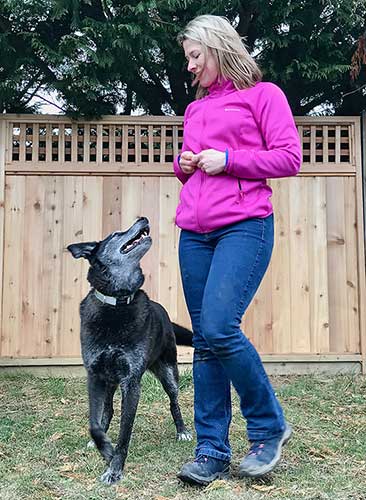


Furrowed brow and hyper vigilance can be signs of worry.
I work with a lot of wonderful dog owners in Vermont who love their dogs dearly. And yet one word comes up in sessions more than almost any other:
Stubborn.
You’ll hear it when a dog won’t come inside.
When they freeze on a walk.
When they won’t “do the thing” they usually do.
Here’s the truth: most dogs aren’t stubborn. They’re communicating.
The dog isn’t giving you a hard time. The dog is having a hard time.
The myth of the “difficult dog”
Against that backdrop, I also hear another phrase constantly:
“He’s great 99% of the time… but when he doesn’t want to do something, he’s so stubborn.”
Dog trainers hear the word stubborn all the time. Some trainers still use it, too.
But modern training asks us to pause and reframe. Because nine times out of ten, what someone is calling “stubborn” isn’t defiance. It isn’t attitude. It isn’t a dominance play.
It’s information.
The dog isn’t intentionally giving you a hard time.
The dog is having a hard time.
And yes—trust me—I know why the word stubborn sneaks in.
You’ve spent weeks or months teaching something. Your dog clearly understands the cue. Your dog can do it beautifully… most of the time.
And then that one moment arrives.
The 1%.
The moment when your dog looks away, freezes, hesitates, or simply opts out. It can feel personal. It can feel like your dog is saying:
“Not a chance, buddy.”
But here’s what I want you to keep in mind:
Your dog isn’t being difficult.
Your dog is overwhelmed.
Dogs repeat what works
Dogs are opportunistic by nature. Many scientists believe dogs essentially self-domesticated—moving closer to humans because proximity brought safety, warmth, food, and opportunity. Dogs that adapted to life near people thrived.
And that matters, because it helps explain what drives behavior: dogs move toward what works and away from what doesn’t.
This is the heart of learning theory.
Behaviors that are reinforcing get repeated. Behaviors that aren’t reinforcing fade out. Punishment can reduce behavior too—but not because the dog suddenly “understands right from wrong.”
Punishment works because the dog learns:
Avoid the consequence.
In other words, the dog doesn’t stop barking, lunging, or pulling because they feel safe, regulated, and confident.
They stop because they feel threatened.
And that’s a very different emotional outcome.
What “stubborn” really looks like
Let’s make it real.
If your dog stays on their bed with their head turned away while you bring out the flirt pole and enthusiastically invite them to play, the answer isn’t that your dog is stubborn.
It’s simply not reinforcing to engage in that moment.

Training might just not be the priority of a dog relaxing!
Maybe they’re tired.
Maybe their body is sore.
Maybe something in the environment feels unsafe.
Maybe they’re overstimulated and need space.
Maybe they’re simply content—and not interested in performing joy on demand.
Modern training acknowledges that dogs are allowed to have preferences. They are allowed to opt in or opt out of some experiences. A well-trained cue increases your dog’s ability to respond reliably, yes—but it doesn’t erase your dog’s emotional life.
If a well-trained dog suddenly can’t respond, I don’t assume attitude.
I assume something changed.
Humans aren’t that different
Learning theory doesn’t just apply to dogs.
Humans repeat what works, too.
Most of us avoid discomfort whenever we can. Most of us gravitate toward things that reward us—approval, ease, safety, relief, belonging. Even when we want to do the “right” thing, we still need support, clarity, and motivation to change our habits.
Which is why I’ve learned something humbling as a trainer:
The “stubborn” client is often just like the so-called stubborn dog.
They aren’t trying to be difficult. They’re overwhelmed. They’re uncertain. They’re afraid of being judged. They’re operating from the only model they’ve ever been shown.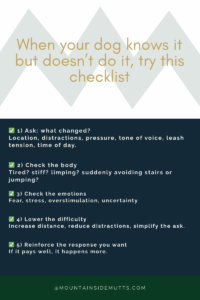
And when I feel myself getting tired—when I want to snap back, Your dog isn’t disobeying you, your dog just doesn’t find you reinforcing—I remind myself:
It’s my job to make change feel possible.
Break it down.
Make it easier.
Help them win.
Someone once told me: All you can do is plant seeds. Some will take root.
That’s true for dogs.
And it’s true for people.
Because more often than not, the story isn’t “stubborn.”
It’s simply this:
Someone is trying their best… while having a hard time.
🐾 Need Help With the “1%”?
If your dog is “great most of the time” but struggles in certain moments — on walks, around distractions, during play, or when asked to do something familiar — it doesn’t mean they’re stubborn. It means something is getting in the way.
At Mountainside Mutts, we specialize in:
-
Compassionate, force-free training
-
Understanding why a behavior is happening
-
Building reliability without fear, pain, or intimidation
-
Helping dogs (and people) feel confident and successful
Whether you’re raising a puppy or living with a dog who’s overwhelmed by specific situations, we’ll break things down, make them achievable, and help everyone win.
👉 Learn more about Puppy Jumpstart, Puppy Start Right®, or private training
👉 Book a consultation at mountainsidemutts.com
Modern training. Real life. Humane solutions.